PPN 026's six criteria ask suppliers for two kinds of thing: better pay and conditions for the people already doing the work, which cost money in every hour of the contract, and a way in for people who are not, which every bidder can offer cheaply. Which kind can put a gap between two real bidders depends on the market, and the model cannot tell you which. Put the obligations every supplier must accept in the specification, and spend the marks on the one or two criteria on which your bidders will actually differ.

In short

What the weighting buys

Two parts of a tender do the work in what follows. The specification says what every bidder must deliver, and a bid that does not meet it is not compliant. The award criteria are what the bids are scored on, and the weighting is the share of the marks each criterion carries; under PPN 026 the social value criteria carry at least 10% or 20% of the total, depending on contract value. The argument of this article is about what belongs in which.

Annex A gives two outcomes, Good Jobs and Skills, with three criteria under each. Three of the six describe how a supplier treats the people already doing the work: fair working conditions (1b), fair pay (1c) and in-work progression (2b). Two ask it to open the work to people who are not in it: training and retraining (2a) and the talent pipeline (2c). The sixth, creating and retaining jobs (1a), does some of each, and the figure sets them out.
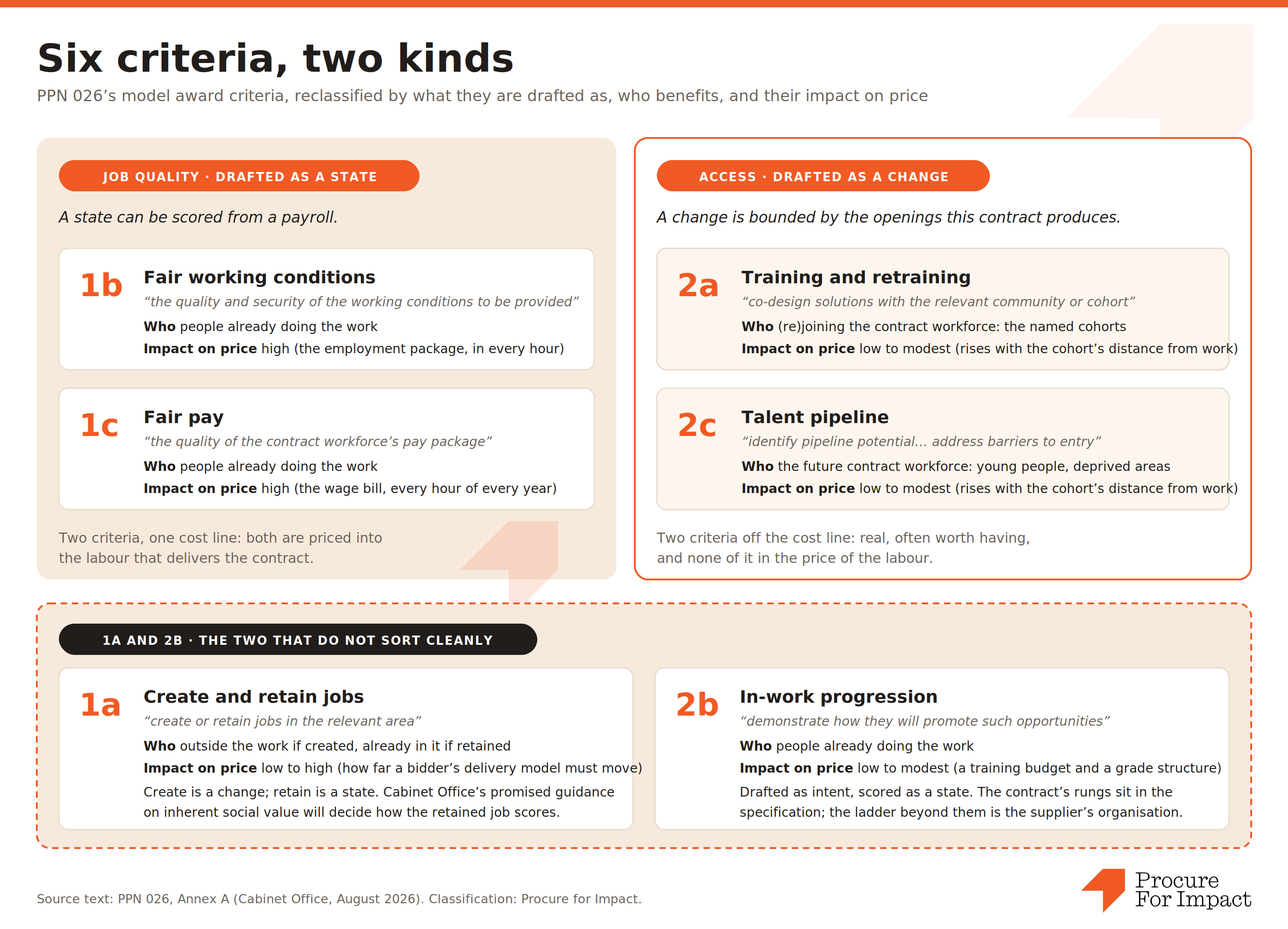
Six criteria, two kinds: PPN 026's model award criteria reclassified by what they are drafted as, who benefits, and their impact on price

Figure 1. Six criteria, two kinds: PPN 026's model award criteria reclassified by what they are drafted as, who benefits, and their impact on price

The sort matters because of what each kind costs a supplier to answer. Pay and conditions appear in the wage bill every hour of every year, which is why 1c is the criterion most likely to separate bidders on price as well as on the page. A recruitment open day, a college partnership and the 45 days of work experience the PPN names as an example are all real and often worth having, and none of them touches the price of the labour delivering the contract. Progression sits in between: it comes out of a training budget, so a supplier can answer 2b well for a great deal less than it costs to answer 1c well. How expensive the training and pipeline criteria get is set by what the authority asks for. The point here is the floor: a cheap version of every training and placement answer exists, and a cheap version of pay does not.

That is why a weighting spread across the criteria scores flat. A bidder that pays the floor cannot close the gap on pay, but it can run the open days and sign the college partnership as cheaply as anyone, and so can every other bidder, so on those criteria the panel reads the same strong answer from everyone and marks them level. The marks themselves are rationed. PPN 026 sets the weighting at 10% or 20% of the total, an authority spends each mark once, and every mark it puts on a question all bidders can answer well is a mark it has not put on pay, which is the one question the bidder paying the floor cannot answer. An authority that mixes the two kinds has not bought both; it has spent part of its weighting where no bidder can lose.¹

20%

The minimum share of the marks PPN 026 puts on social value for contracts of £5m and above, and 10% from £1m. An authority spends each mark once.

PPN 026, paragraph 13

Which criteria can separate your bidders?

The first question is not which criteria to weight. It is whether the contract has any labour close to the wage floor. The pay criterion awards points to suppliers who go further than the statutory minimum wage and reward staff through progressive remuneration policies (Annex A, 1c), and in-work progression awards them for helping people move into higher paid work (2b). Both assume a workforce with somewhere to go from the floor, and a criterion the bidders cannot differ on is neither relevant to the subject matter nor proportionate, which is the test paragraphs 8 and 13 set. So the wage profile of the contract workforce picks the outcome before anyone has weighted anything. Labour near the floor, and Good Jobs is live, and the budget then decides how pay is handled: the floor the authority has funded is required in the specification, and whatever it has not funded, or wants above that floor, is what the bidders compete on. No labour near the floor, and the choice is Skills.

Labour-dominant services (cleaning, catering, security, facilities). The workforce transfers under TUPE (the Transfer of Undertakings regulations, which move staff to the new contractor on their existing terms), so every bidder inherits the same people on the same terms, and the difference between bids is what each proposes to do with the pay package from the first day. The first article in this series showed why that is a budget decision before it is a social value one: the public sector sets the pay it is willing to fund, and the bidders price to it. Within that budget, pay is the one criterion on which a gap capable of changing who wins exists at all. Whether it does depends on the weighting, the scoring scale and how far apart the bidders are on price, which is the third article in the series' arithmetic.

The temptation in these markets is to weight the criteria that count new entrants, training places and placements, because the numbers are large and every bidder can offer them. The number that should sit beside them is turnover. CIPD's analysis of the ONS Annual Population Survey (2022 to 2023) puts UK turnover at around 34% a year, and 52% in accommodation and food services, which covers contract catering. An employer filling the same post five times in a year can report five people helped into work, and has created one job nobody can afford to keep. A weighting that rewards new entrants in volume, on a contract where the pay is at the floor, is rewarding the turnover. Retention, progression and the pipeline all assume the job is worth keeping, and on these contracts pay is what makes it so.

Professional services (design, engineering, consultancy, legal). Above the floor, so pay separates nobody and the marks go to Skills. The decision the contracting authority has to make is whether it is investing in a sustainable future workforce for the sector, because that is what the Skills criteria buy here and it costs money. The gap between bidders is the trainee or apprentice seat: whose commission the junior gains experience on, and who pays for the supervised hours. Those hours cost a salary, a qualified supervisor's time and slower delivery while the trainee learns, so either they sit in the workforce specification and the rate card, paid by the client, or they arrive pro bono, and pro bono hours are the first thing delivery pressure removes. If the criteria ask for the trainees, the client pays for the trainees. The specification buys the seats; the marks (2a, 2c) are for who fills them and by which route, and where the authority wants the seats to go to the people Annex A names, those not in employment, education or training, those moving from education into work, people with a long-term health condition or disability, and care leavers, it says so in the criterion.

Construction and the built environment. The workforce is assembled for the job rather than inherited, much of it through subcontractors and agencies, so no criterion separates bidders until the delivery model is fixed: who employs whom, and where. A pay criterion reaches only the direct workforce unless the specification carries it down the supply chain, and the training and pipeline criteria have to reach the same chain. Construction is one of Skills England's priority sectors, which puts 2a and 2c in play once the model is settled. A separate piece takes this sector on its own terms.

34%

UK employee turnover a year on average, rising to 52% in accommodation and food services. A weighting that rewards new entrants in volume on a contract paying the floor is rewarding the turnover.

CIPD analysis of the ONS Annual Population Survey, 2022 to 2023

Obligations in the specification, marks on one or two criteria

Award criteria can do two things. They can decide who wins, which is what paragraph 13 uses them for when it awards points, and they can extract commitments from whoever wins, which is what paragraph 16 turns them into when it asks for every commitment made in the procurement to be monitored through KPIs. Asked to do both at once across six criteria, they produce a long response from each bidder and a contract manager left holding a set of promises that were written to score rather than to be kept.

There is a third way, and it is the one this article recommends. The obligations the authority wants from any supplier go into the scope and the specification: the pay floor, the conditions, the trainee seats in the rate card, the reporting. Every bidder signs up to them as a condition of the contract, and none of them is scored. The marks go on the one or two criteria on which the bidders will actually differ, chosen by the wage profile and the market as the previous section set out. The supplier that wins has accepted the full range of obligations and has been assessed on the one or two things it had to be better at. Fewer criteria are evaluated; no fewer obligations are signed. The weighting the PPN requires, 10% or 20% of the marks depending on contract value, still has to be spent on model award criteria, so the third way narrows the marks rather than emptying them.

Fewer criteria are assessed; no fewer obligations are signed.

Can an authority require pay and conditions for the contract workforce as terms of the contract? The Procurement Act 2023 does not say it cannot. An authority's requirements sit in the tender documents (section 21) and are governed by the same duties as everything else in the procurement: suppliers treated the same (section 12), technical specifications that do not favour a particular supplier (section 56), no discrimination against treaty-state suppliers (section 90), and the PPN's own test in paragraph 8 that what is asked for is relevant to the subject matter and proportionate. A pay floor for the people delivering this contract meets those tests by the same route MAC 1c does, since the PPN's own criterion presupposes that the pay of the contract workforce is the authority's legitimate business, and Living Wage Foundation accreditation, which a number of public bodies hold, already requires it of their contracted staff. What would not pass is a condition reaching across a supplier's whole business, or one drafted so that only a local supplier could meet it. Each contract's lawyers settle this on its facts; this article states the reading, not the answer.

Paragraph 13 allows it. The instruction is to select a relevant delivery outcome from Annex A with its corresponding award criteria and include it in the tender documents: one outcome, Good Jobs or Skills, with the criteria that sit under it. It fixes the total weighting and says nothing about how that total is divided among the outcome's three criteria, so an authority that has selected Skills can put nearly all of its social value marks on the talent pipeline and carry training and progression at a low weighting. That is our reading of the text, and we expect most tender templates to read it as a list of six with a tick box against each, because that is how the criteria sit on the page and how the previous edition of the model was used.²

So pay is handled twice on a labour-dominant contract, and the budget decision from the first article says where the line falls. Pay is required to the level the budget funds and competed above it. If the budget funds only the statutory floor, requiring more would be an unfunded promise, so pay is the competition: fair pay (1c) carries the marks, and the bidders differ on what they offer above the floor and what they price for it. If the budget funds the Real Living Wage, it is required, every bidder prices to it, and the competition moves to what remains, progression above the required rate or the Skills criteria. The gap that decides the winner is smaller in the second case because the authority has already bought most of the improvement itself, which is the point: an authority that requires the floor has chosen to pay for better pay rather than hope a bidder offers it.

One criterion or two follows from the same logic. One where a single dimension carries the whole difference between bidders, as pay does on a transferred workforce at the floor. Two where the selected outcome's criteria measure two things the market really varies on, as training and the pipeline do under Skills, where the route in and the future workforce are different purchases. A criterion added to make the weighting look rounded is a criterion every bidder will match.

Criteria fight each other in the marks when one set is asked to do both jobs, and they fight across the tender documents too. The first article in this series put it as a rule: the specification, the bidder's promise and the price have to describe the same workforce. A specification that assumes the transferred staff on their current terms, a social value response that promises the Real Living Wage, and a price that has not funded the difference are three descriptions of three different contracts, and the contract manager inherits the gap. Putting the obligations in the specification is what closes it, because a bidder prices what the specification requires.

Creating and retaining jobs (1a) depends on a decision only the authority can make: where it wants the work delivered from. Jobs created or retained in the relevant area are a property of the delivery model, and the delivery model is set in the specification, which is the budget decision from the first article again. Once that is stated, 1a can separate bidders, because a supplier already delivering from the area answers it cheaply and one that would have to move roles has to price the move. It is also the criterion to draft with most care, since a question about where jobs sit is close to a local preference, and paragraph 8 and section 90 of the Procurement Act 2023 both limit that.

On a facilities contract above £5m with a transferred workforce at the floor, the two forks look like this. If the budget funds the Real Living Wage: the specification requires it, with sick pay above the statutory minimum and union access for the contract workforce; the 20% goes on fair pay (1c), scored on the progression a bidder offers above the required rate and the share of the workforce it covers; the coverage figure becomes the social value KPI paragraph 17 asks for; training and placements are obligations, reported through the same KPIs and not scored. If the budget funds only the statutory floor: pay stays in the marks, 1c takes the 20%, scored on the rate and coverage a bidder offers above the floor and prices in its bid; conditions, training and placements are obligations and not scored. Both are illustrative.

The third way has a cost, and it should be named rather than hidden. Bidders compete upward only on what is scored. A requirement in the specification buys the floor every bidder must meet; it buys no ambition above it. The one or two criteria that carry the marks are where the authority gets more than it asked for, and choosing them is choosing which dimension of the contract deserves the competition.

£5m

The contract value at and above which PPN 026 asks for at least one social value KPI, in addition to the three section 52 of the Procurement Act already requires. Coverage of the pay rate is a number that fits it.

PPN 026, paragraph 17; Procurement Act 2023, section 52

Drafting the one or two so a panel can score them

Whichever one or two criteria carry the marks, they only buy something if the question is one a panel can score and a contract manager can later check.

For pay, the number is coverage. A bidder can commit a rate for its directly employed core and say nothing about the agency staff covering peaks and absence, or the subcontractor doing the specialist work, and score well on 1c while a third of the contract workforce sits outside the commitment. The question to ask is not whether a bidder pays the rate but what proportion of the hours in the specification the rate applies to. That is a number, and it can be carried into the social value KPI paragraph 17 asks for on contracts of £5m or more, alongside the three that section 52 of the Procurement Act 2023 already requires, rather than left in the narrative.

For training and the talent pipeline, name the change being bought: which cohort, in which area, through which route, and how anyone would know it happened. The cohort is also the cost lever, and it is the authority's to set. An authority content with local hires should require them in the specification and score nothing deeper. One that wants the cohorts furthest from work, the people Annex A names, should say so in the criterion and ask for the cost of reaching them to be visible in the bid, because supporting somebody a long way from employment means pre-employment programmes, supervised placements and the workplace adaptations Annex A itself gives as examples, and an unpriced version of that promise will not survive delivery. The looser the criterion, the more likely a panel is to reward the better-written answer rather than the better offer.

For creating and retaining jobs, name the benchmark. The criterion asks whether opportunities to meet Labour Market Strategy objectives will be met through delivery of the contract, and the PPN does not say which strategy it means. Whichever one an authority picks needs naming in the tender documents, because a bidder cannot answer a criterion whose benchmark is unstated.³

What to do now

1. Ask the wage-floor question first. An hour with the incumbent's workforce profile and the likely bidders tells you whether the contract has labour near the floor, and with it which outcome is live. The market research the PPN asks for before selecting criteria (Annex A notes) is this exercise, not a box.

2. Put the obligations in the specification and the marks on one or two criteria. Every bidder signs up to the pay floor the budget funds, the conditions, the trainee seats and the reporting as terms of the contract. The 10% or 20% goes on the one or two criteria on which the bidders you will get can still differ, and nothing else is scored. That choice is for the budget owner and the contract manager as much as for the commercial lead.

3. Where nothing fits, say so. If no criterion can be written for this contract that a panel can score and a contract manager can check, paragraph 8 does not ask you to invent one. Record the relevance and proportionality decision and move on; that is the model applied, not avoided.

Some of this may not survive the autumn. The sub-criteria will attach under each criterion and may narrow what a panel can score. The promised guidance on existing, inherent social value will decide how a retained job scores under 1a. The guidance may fix how the weighting divides within an outcome, and the evaluation method for community programmes is still to come. Our working assumption is that none of these changes the wage-floor question or the case for putting obligations in the specification, and we would be glad to hear from anyone applying either in a market we have not described, or with a counter-example to the reading of paragraph 13.

The third article in this series will set out what the marks are actually worth at evaluation, where a weighting either changes who wins or just describes itself as 20%. A separate piece will take the sector question into construction and the built environment.

Notes

  • ¹ Community programmes are a further way for marks to travel away from the contract workforce. Paragraph 13 attaches relevant entries from the List of Community Programmes to the tender documents and paragraph 16 asks for a KPI monitoring delivery where a supplier offers to support one, but the evaluation methodology arrives with the autumn guidance. Until it does, a community programme can be offered against any criterion an authority opens up. The third article returns to this.
  • ² Exposed positions, restated here from the findings: the reading of paragraph 13 has surfaced in early commentary but nobody has tested it, and the autumn guidance may treat the six as a free menu or fix the split within an outcome. The state-and-change classification in the figure is our reading of Annex A, and the promised guidance on existing, inherent social value may land elsewhere, most likely on the retention leg of 1a.
  • ³ The nearest national candidate is the Get Britain Working white paper (DWP, November 2024), whose cohorts line up with the PPN's; the nearest local one is the area's own Get Britain Working plan, which suits a criterion about jobs in the relevant area better than a national document does; Skills England covers the skills side. What an authority should not reach for is the UK Labour Market Enforcement Strategy, published annually under the Immigration Act 2016. It is about enforcement against non-compliant employers rather than about opportunity, and it is the first thing a search returns.

Sources

  • PPN 026: The Social Value Model, Cabinet Office, August 2026 (paragraphs 8, 13, 14, 16, 17, Annex A and its notes).
  • Procurement Act 2023, sections 12, 21, 23, 52, 56 and 90.
  • Employee turnover by industry: CIPD analysis of the ONS Annual Population Survey, 2022 to 2023.
  • Get Britain Working, Department for Work and Pensions white paper, November 2024, and local Get Britain Working plans.
  • Skills England sectoral priorities.
  • UK Labour Market Enforcement Strategy, Director of Labour Market Enforcement, published annually under section 5 of the Immigration Act 2016.
  • Living Wage Foundation: Real Living Wage rates and employer accreditation requirements.
  • List of Community Programmes, published alongside the PPN 026 guidance.